Birth Flower Water Lily Graphics for Crafts
As someone who’s launched over 200 digital product listings across Etsy, Creative Market, and Shopify—and scaled three print-on-demand shops—I opened Birth Flower Water Lily expecting a standard floral clipart file. What I got instead was a quietly confident design asset: soft but intentional, botanical but not fussy, feminine without leaning into cliché. It reads as both timeless and commercially flexible—exactly what you want when building a cohesive, scalable collection.
First Impression: Mood, Audience, and Niche Fit
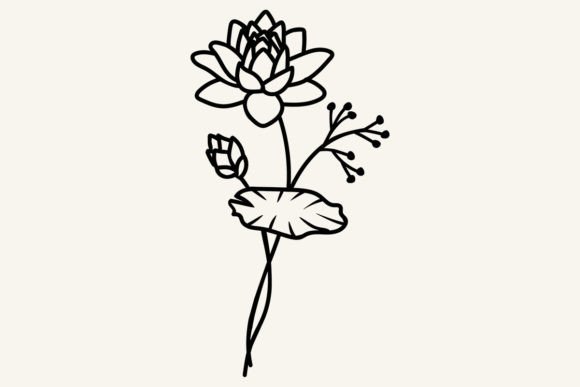
The Birth Flower Water Lily lands with gentle elegance—not overly ornate, not minimalist to the point of sterility. Its hand-drawn texture gives it warmth, while clean linework ensures scalability. It feels like a natural fit for July-themed collections: bridal showers, summer baby announcements, garden party invites, or mindfulness-focused wall art. Buyers tend to be women aged 28–45 running handmade businesses, wellness blogs, or small stationery brands—people who value authenticity over trend-chasing.
This isn’t a “cute” or “playful” water lily. It’s serene, slightly poetic, and subtly decorative—ideal for customers seeking refined visual storytelling rather than cartoonish charm. That makes it stronger for premium printable designs, Canva templates, and boutique merchandise than for kids’ craft kits (unless paired intentionally with bolder supporting elements).
Real-World Product Testing Scenarios
Before publishing any listing, I always run Birth Flower Water Lily through five quick tests:
- SVG cut test in Cricut Design Space: Does the outline hold up at 2" size? Are inner details too fine for vinyl weeding? (This one passes cleanly at 1.5"+ with minimal nested layers.)
- Print preview on matte cardstock: Does the shading translate well without ink bleed? (Yes—especially with light-to-medium gray tones.)
- Mockup integration: How does it sit on a mug mockup vs. a framed wall art preview? It shines in soft-focus lifestyle shots—less so on high-contrast tech gadgets.
- Thumbnail scan: At 120px width, does it read as “water lily” and not just “blob”? It does—thanks to clear silhouette and balanced negative space.
- Background contrast check: Works reliably on white, cream, and light sage—but fades on charcoal unless given a subtle drop shadow or white stroke.
Where This Graphic Design Asset Adds Real Value
Birth Flower Water Lily excels where visual harmony matters most. Use it to anchor:
- Printable wall art sets—paired with minimalist typography and coordinating birth month florals for cohesive nursery or office decor bundles.
- Invitation templates in Canva: Layer it behind a script font headline or tuck it into a corner as an elegant accent.
- Sublimation designs for mugs and tumblers—its organic shape avoids the rigidity that often clashes with curved surfaces.
- Digital paper packs: Repeat it subtly as a watermark or full-bleed background for planner inserts or journal covers.
- Social media graphics for small business branding—think Instagram story banners or Pinterest pins for “July Birthdays” content calendars.
It also strengthens perceived value in design bundles. Bundling Birth Flower Water Lily with matching leaves, seed pods, or abstract water ripples creates instant cohesion—and raises average order value without extra production time.
Where to Proceed With Care
This is not a one-size-fits-all workhorse. Avoid using Birth Flower Water Lily in contexts where clarity trumps atmosphere:
- Tiny sticker sheets: Fine petal details vanish below 0.75". Stick to simplified versions or pair with bolder companion icons.
- Text-heavy templates: Its gentle presence gets lost next to dense body copy. Reserve it for headers, dividers, or standalone visual moments.
- Dark-background merch: Without proper outlining or layering, it loses definition. Always pre-test on black or navy mockups.
- Crowded thumbnails: In grid-based marketplaces like Etsy search results, it competes poorly against high-saturation or typographic assets—so pair it with strong color-blocking in your listing visuals.
Practical Seller Notes You’ll Actually Use
Here’s what I do before uploading any product featuring Birth Flower Water Lily:
- Verify PNG transparency in Photoshop—no stray pixels or anti-aliasing halos.
- Export SVG at 300 DPI and inspect paths in Inkscape for unintended compound shapes or overlapping nodes.
- Test print on two substrates: uncoated cardstock (for invitations) and glossy photo paper (for wall art). Note color shifts—especially in cooler blue-green tones.
- Organize files clearly: “WaterLily_SVG”, “WaterLily_PNG_300dpi”, “WaterLily_BW_LineArt” — no vague naming.
- Pair it with at least three font types in mockups: a delicate serif (e.g., Playfair Display), a friendly sans (e.g., Montserrat), and a restrained script (e.g., Adorn Script) to show versatility.
- Double-check commercial license terms—this asset permits finished goods, but never resell the raw file as standalone clipart.
Final Verdict for Digital Product Creators
Birth Flower Water Lily won’t go viral overnight—but it builds trust, supports consistency, and quietly elevates your shop’s aesthetic authority. It’s the kind of graphic design asset that makes customers pause mid-scroll because it feels *considered*, not generic. For sellers building seasonal collections, launching birth month subscription boxes, or expanding into printable planners and wedding suites, it’s a low-risk, high-return addition to your design assets library.
Just remember: its strength lies in restraint. Let it breathe. Pair it with space, intention, and complementary simplicity—and it becomes more than clipart. It becomes part of your brand’s visual language.